Noise Cancelling Microphone

Noise Cancelling Microphone

Honeywell Safety Sync Wired

Noise Cancelling Microphone

Honeywell Safety Sync Wired Electronic Ear Defenders with Headband, 29dB, Noise Cancelling Microphone

Ear defenders protect the user from damaging their hearing when working in noisy environments, providing noise reduction or cancellation. The two main types of ear defenders include passive and electronic, which both encase the ear for protection.

Passive ear defenders use acoustic foam pads to absorb sounds and act as a barrier to stop harmful levels of sound from reaching the ears. They use acoustic foam to attenuate (reduce the impact of) incoming sounds whilst offering comfort for prolonged use.

Electronic ear defenders have a similar makeup to passive ear defenders, except for the small, built-in sensor that detects noise levels and adjusts the level of attenuation to provide noise protection accordingly.

Communication ear defenders use the base of electronic ear defenders with the addition of a microphone, radio and Bluetooth functionalities. They offer similar attenuation capabilities as passive and electronic defenders, blocking out low to medium noise, whilst allowing you to hear higher frequencies such as voices and alarms clearly. FM Radio ear defenders allow the user to listen to music or the radio whilst working. Lastly, the built-in communication allows the user to listen or speak and listen to other workers on the same frequency when working and still staying protected.

General Purpose Gloves

General Purpose Gloves

RS PRO Black/Red Nylon

General Purpose Gloves

RS PRO Black/Red Nylon General Purpose Gloves

Work gloves are a type of protective personal equipment, they are hand coverings used as compulsory work clothing in various industries to ensure occupational safety. Work gloves are typically specialised for a specific hazard or role, meaning their form and function can vary considerably. Regardless of specialisation, using work gloves improves user comfort and minimises the risk of minor injuries to the hands.

Explore quality work gloves from providers such as Ansell, Uvex, and BM Polyco. Discover more information on the various applications and features by visiting our work gloves guide.

Choosing the best materials for your requirement

Searching for leather work gloves? Leather is a durable material that is also flexible, it creates puncture resistant gloves that protect against abrasions without sacrificing the dexterity needed to perform intricate tasks.

Leather is a favourable material for numerous applications and is frequently combined with liners or coatings of other materials to extend its suitability.

Disposable Overalls

Disposable Overalls

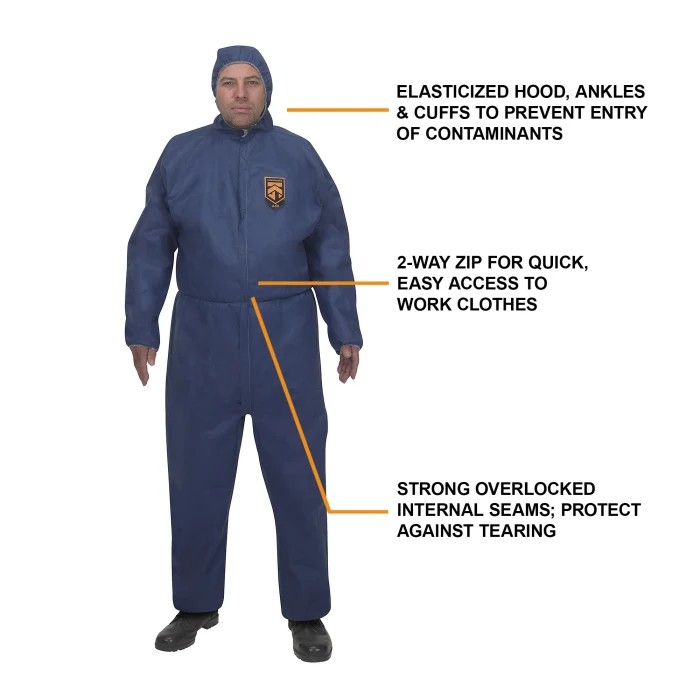
Kimberly Clark Blue Disposable

Disposable Overalls

Kimberly Clark Blue Disposable overalls

Protective clothing comes under the umbrella of Personal Protective Equipment (PPE) & Workwear, which is designed to ensure the safety of workers and visitors alike in a variety of environments and applications. Protective clothing is a crucial part of daily protection in some workplaces, protecting the user from hazardous materials and/or chemicals, contamination, liquid splashes, dirt, dust, oils, high/low temperatures and heavy equipment.
Our range of protective clothing includes products from trusted brands such as Dickies, 3M, Kimberley Clark, Alpha Solway, Delta Plus and our very own trusted, quality brand, RS PRO. We pride ourselves for supplying leading protection that meets the required safety standards across several industries, including construction, utility, engineering, mining, manufacturing, health, education and more.

Importance of protective clothing?

Protective clothing in all its types exists to prevent injury and/or harm coming users on all parts of the body including the head, face, hands, arms, feet and the torso. There are different types of equipment and clothing available depending on the tasks or hazards the wearer will be exposed to, such as flame-retardant, chemical-retardant, antistatic and anti-abrasion.

Even though it is most clearly seen on construction sites in the forms of hi-vis, head protection and protective footwear, protective clothing is not just used on work sites. The vast array of products that fall under protective clothing also includes workwear used in: the hospitality and food industries to prevent cross-contamination and infection, chemical industries to prevent clothing damage and personal injury, and many other industries such as automotive, decorating and mechanical to protect skin and clothing from any fluids that may stain or cause irritation.

Head Protection

Head Protection

Portwest Blue Safety Helmet,

Head Protection

Portwest Blue Safety Helmet, Adjustable

Hard hats are also known as safety helmets, an item of PPE (personal protective equipment). Hard hats protect your head from falling objects and impact from other objects also protecting from electrical shock. Hard hats are worn within roofing and construction, also in forestry and offshore industries. They can be worn any environment by anyone. Hard hats are a legal safety requirement for you to wear on construction sites worldwide. You can find out more in our hard hats guide.
How are they constructed?
Hard hats are made from strong plastic such as HDPE (high-density polyethylene). There are suspension bands within the helmet that spread impact force over the top of the head, reducing injury. Hard hats can be supplied with a chin strap or ratchet adjustment keeping the hat firmly in place. Some models are vented to keep your head cool whilst working, for example, the Petzl Helmet range.

Types of Hard Hats

The helmet type defines the impact protection.Hard hats provide impact protection from objects hitting the top of your head.Hard hats provide protection from top and lateral impacts. You are protected from objects hitting the top of your head and from the side, or off centre.
Hard Hat Classes
The helmet class defines the level of electrical protection.Class E (Electrical) hard hats provide protection against falling objects and electrical exposure up to 20,000 V.Class G (General) hard hats offer protection against falling objects and electrical exposure up to 2,200 V.Class C (Conductive) hard hats offer protection from falling objects but provide no dielectric protection from electrical exposure.